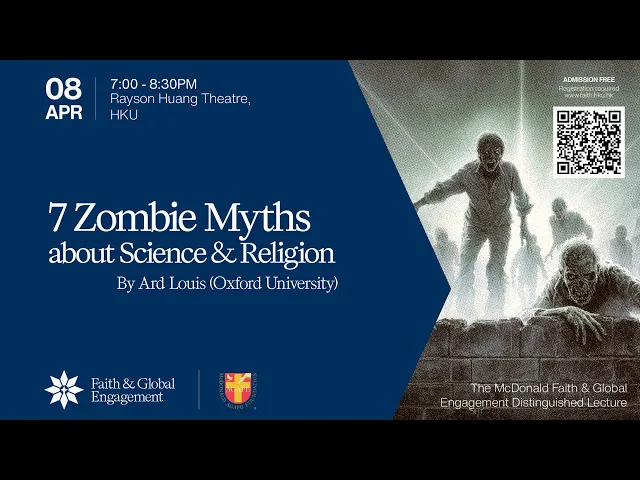
Ard Louis: 7 Zombie Myths About Science & Religion
Ard Louis: 7 Zombie Myths About Science & Religion

Abstract
If science can explain the origins of species and the structure of the cosmos, if its applications can make us healthier and wealthier, then it is tempting to ask why it should not also arbitrate the big questions: what is good and what is evil, how ought we to live, and what—if anything—is the purpose of life? The so-called debate between science and religion is often a proxy for this broader question about the boundaries of science. How far should its jurisdiction extend beyond the natural world it has so triumphantly illuminated? Unfortunately, this debate is persistently clouded by a set of hardy misconceptions—zombie ideas that refuse to stay dead, no matter how often they are dispatched. We must first clear them away before we can have a rational conversation about the role of science and religion in the big questions of life.
About the Speaker
Ard Louis is a theoretical physicist with a broad interdisciplinary set of interests, including self-assembling DNA, theories of evolution, the dynamics of soft matter, machine learning and applications of algorithmic information theory. He happily collaborates with biologists, chemists, computer scientists, mathematicians, philosophers and theologians. After his first degree in physics from the University of Utrecht, he completed a PhD with Neil Ashcroft atCornell. He was a Royal Society Research Fellow in Theoretical Chemistry at the University of Cambridge, before moving to the Rudolf Peierls Centre for Theoretical Physics at the University of Oxford. He was awarded the 2025 Institute of Physics Sam Edwards Medal and Prize and medal for “For pioneering the development of novel mathematical and numerical models that have contributed to understanding of soft matter and biological physics across length scales.”
Speaker Information
Prof. Ard Louis
Oxford University

Abstract
If science can explain the origins of species and the structure of the cosmos, if its applications can make us healthier and wealthier, then it is tempting to ask why it should not also arbitrate the big questions: what is good and what is evil, how ought we to live, and what—if anything—is the purpose of life? The so-called debate between science and religion is often a proxy for this broader question about the boundaries of science. How far should its jurisdiction extend beyond the natural world it has so triumphantly illuminated? Unfortunately, this debate is persistently clouded by a set of hardy misconceptions—zombie ideas that refuse to stay dead, no matter how often they are dispatched. We must first clear them away before we can have a rational conversation about the role of science and religion in the big questions of life.
About the Speaker
Ard Louis is a theoretical physicist with a broad interdisciplinary set of interests, including self-assembling DNA, theories of evolution, the dynamics of soft matter, machine learning and applications of algorithmic information theory. He happily collaborates with biologists, chemists, computer scientists, mathematicians, philosophers and theologians. After his first degree in physics from the University of Utrecht, he completed a PhD with Neil Ashcroft atCornell. He was a Royal Society Research Fellow in Theoretical Chemistry at the University of Cambridge, before moving to the Rudolf Peierls Centre for Theoretical Physics at the University of Oxford. He was awarded the 2025 Institute of Physics Sam Edwards Medal and Prize and medal for “For pioneering the development of novel mathematical and numerical models that have contributed to understanding of soft matter and biological physics across length scales.”
Speaker Information
Prof. Ard Louis
Oxford University