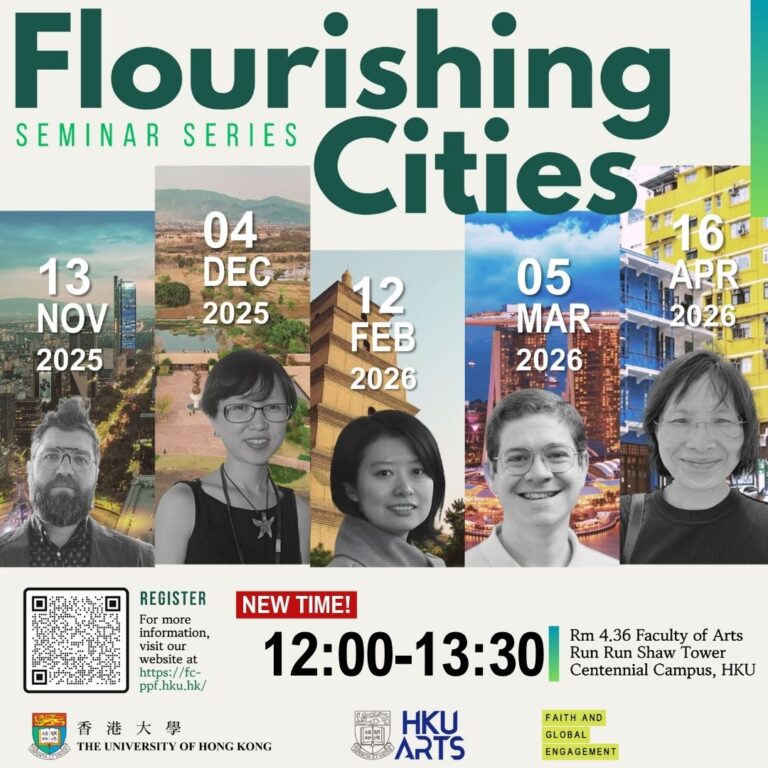


Liangzhou Ancient capital (良渚古都): a world heritage site and its modern meaning
Prof. CAO Kang
Zhejiang University
Date: 04 Dec 2025 (Thur)
Time: 12:00 pm – 1:30 pm
Venue: Rm 4.36, 4/F, Run Run Shaw Tower, Centennial Campus, HKU
Abstract
This lecture examines China’s Liangzhu UNESCO World Heritage Site (2019) through three perspectives. Historically, Liangzhu (c. 3300-2300 BCE) challenges traditional criteria for civilisation by demonstrating a complex society without a full writing system. It demonstrates that Chinese civilisation extends back 5,000 years and reveals a multi-centric origin beyond the Yellow River, from its Yangtze River location. Geographically, the “Liangzhu Ancient Kingdom” extend political, economic, and religious influences over the Lake Taihu region, with its core at Liangzhu Ancient City. This integrated realm is evidenced by shared beliefs, technologies, and transport networks. In planning and design, the ancient city’s layout shows conscious urban planning that influenced later Chinese capitals. Its “living alongside rivers” residential concept persisted in the lower Yangtze region, and its iconic jade tubes profoundly impacted the artistic design of contemporaneous civilisations.
About the Speaker

Professor CAO Kang is Associate Professor of Urban Planning at Zhejiang University, China. She focuses on planning theory and planning history in research. In the realm of planning theory, she examines its ancient Chinese philosophical traditions and evolutionary mechanisms from the perspectives of physics and evolution theory. Regarding planning history, she explores fundamental issues such as methodological approaches within the field, as well as the interrelationships between planning history and related disciplines, e.g., urban and architectural history. Currently, she is particularly interested in the flow and transfer of planning knowledge across different types of borders.