Faith and Global Engagement x Facaulty of Arts Public Seminar
AI AND THE FUTURE OF THE UNIVERSITY
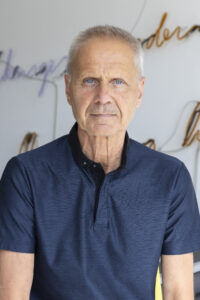
Michael Schindhelm
Author, filmmaker, curator, cultural consultant, quantum chemist
Respondents:
Professor Jay Siegel, Vice-President (Teaching and Learning), HKU
Professor Rachel Sterken, Associate Dean, Faculty of Arts, HKU
Date: 19 MAR 2026 (Thur)
Time: 5:30pm – 7pm
Venue: Rayson Huang Theatre, HKU
Abstract
As Artificial Intelligence accelerates toward agentic autonomy in 2026, the global academy faces an existential “pivot point.” For centuries, the university has functioned as a repository for explicit knowledge, the facts, formulas, and logic that can be codified and transmitted. However, as the marginal cost of explicit information plummets toward zero, the university’s traditional value proposition is collapsing. This lecture argues that the survival of human expertise depends not on competing with algorithmic speed, but on doubling down on what Michael Polanyi termed “tacit knowledge”: the deeply embodied, intuitive wisdom that remains uncodifiable and biologically Anchored.
Drawing on contemporary neuroscience, specifically Dual-Process Theory and the Somatic Marker Hypothesis, I identify a burgeoning crisis of “Cognitive Debt.” Empirical evidence suggests that over reliance on frictionless AI is hollowing out human neural architecture, reducing functional connectivity by as much as 55%. To counter this, I propose a radical shift in pedagogy from efficiency to Strategic Friction. This model reintroduces “desirable difficulty” into the learning process through specific cognitive forcing functions.
By moving from STEM-centric “Logic Engines” to a transdisciplinary synthesis with the Humanities (HAS), the university can cultivate the “Pattern Breaker”: a leader capable of exercising moral authorship over machine output. Ultimately, we must move from externalizing human knowledge to train AI, to internalizing machine insights to enrich human intuition. The mission of the future university is to ensure that in an age of automated thought, the “Ghost in the Machine” remains human.
About the Speaker

Michael Schindhelm (1960) is a German-born Swiss author, filmmaker, curator, and cultural consultant, known for his multifaceted contributions to the arts. He has served as the director and artistic director of the Theater Basel from 1996 to 2006. He was the founding director of the Dubai Culture & Arts Authority in 2008 and the general director of the Berlin Opera Foundation from 2005 to 2007. Between 209 – 2012 he was involved in the master planning of the West Kowloon Cultural District of Hong Kong. His extensive career includes accolades such as the Bavarian Theater Prize for Theater Basel in 1999 and 2001, and more recently, the Herbert Quandt Media Prize and the German Business Film Prize for his 2022 documentary “A Vaccine at the speed of Light” (about the creation of the first vaccine against Covid-19). Beyond his professional achievements, Schindhelm has a rich academic background, having studied Quantum Chemistry in the USSR, worked at the Academy of Sciences in Berlin, and universities in Zurich, Hong Kong, Singapore and Moscow. He contributed to literature with fiction and non-fiction books. His cinematic endeavours include documentaries about the social transformation in the People’s Republic of China and the art scene in Hong Kong like "Bird's Nest” in 2008, "The Chinese Lives of Uli Sigg" in 2016, and "In the Mood for Art" about the M+ Museum in Hong Kong in 2023. More recently, he created the internationally acclaimed immersive series of art exhibitions “Bids for Survival” and the multimedia show “After the Deluge”, a speculative future scenario about a possible global climate collapse.